
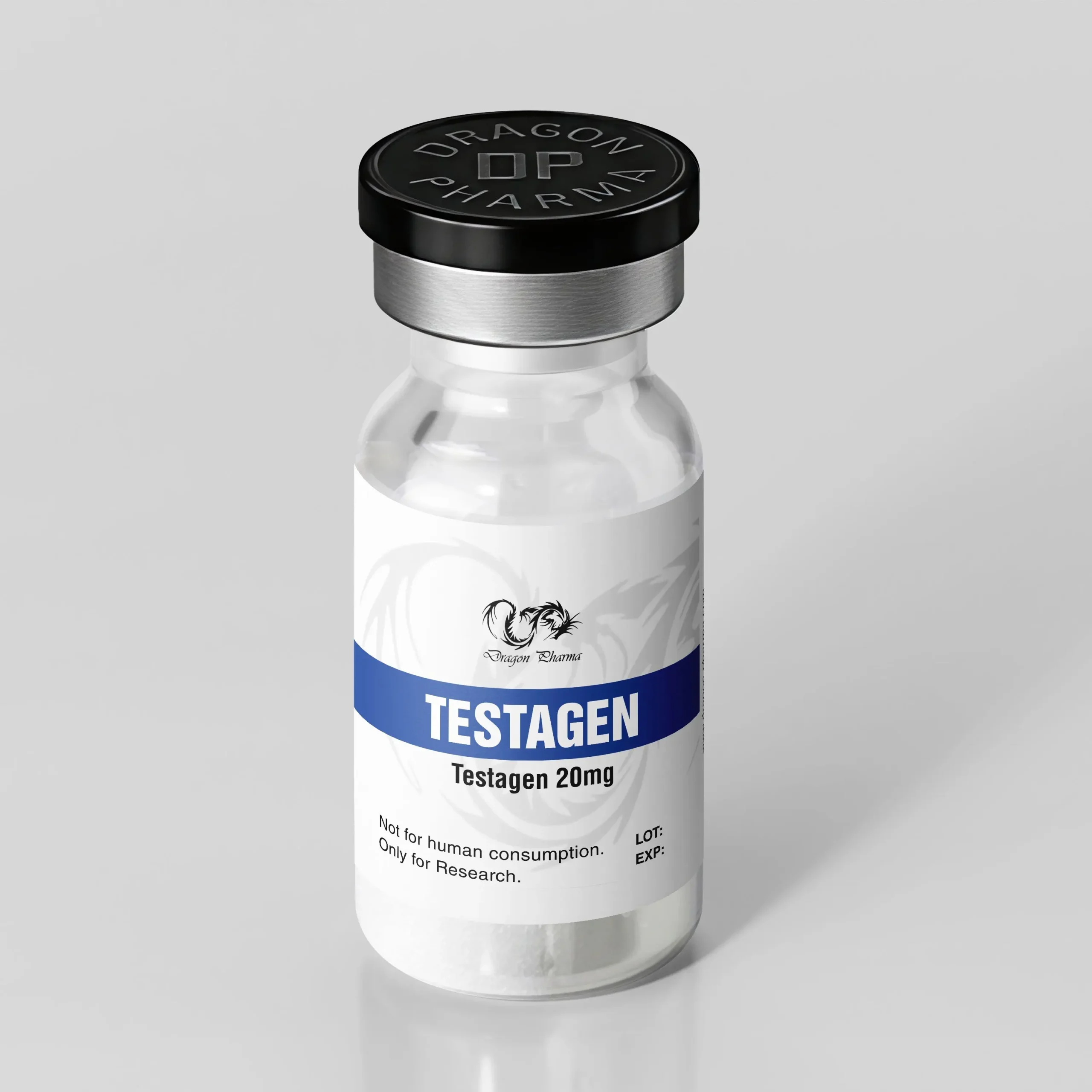
Testagen
Original price was: $108.00.$64.80Current price is: $64.80.
Dragon Pharma Testagen Peptide Dragon Pharma Testagen is a research-grade synthetic tetrapeptide bioregulator composed of the amino acid sequence Lysine-Glutamic acid-Aspartic acid-Glycine, represented in single-letter code as KEDG. Ships US-only · 1–3 business days · Authorized Dragon Pharma distributor.
Testagen – Product Overview
Peptide Dragon Pharma Testagen is a research-grade synthetic tetrapeptide bioregulator composed of the amino acid sequence Lysine-Glutamic acid-Aspartic acid-Glycine, represented in single-letter code as KEDG. Originally isolated and characterized by Professor Vladimir Khavinson and colleagues at the St. Petersburg Institute of Bioregulation and Gerontology as the active component of anterior pituitary tissue extracts, Dragon Pharma Testagen belongs to the cytogen class of ultrashort peptide bioregulators — endogenous regulatory molecules that act at the nuclear level to modulate tissue-specific gene expression.
Dragon Pharma Testagen's research profile spans three interconnected biological domains: its high-affinity interaction with cellular amino acid and peptide transporters (LAT1, LAT2, PEPT1), its documented activity in hypothalamic-pituitary-thyroid axis regulation in preclinical hypophysectomy models, and its capacity for nuclear membrane penetration and direct DNA interaction — the characteristic mechanism shared by the broader Khavinson short-peptide bioregulator family.
A structurally adjacent peptide differing by one C-terminal residue, KEDW, has been characterized binding along the DNA major groove and regulating pancreatic differentiation factor expression, providing a comparative framework for KEDG's nuclear activities. Dragon Pharma Testagen is supplied as a lyophilized powder verified at ≥99% purity by HPLC with LC-MS molecular identity confirmation.
Every batch ships with an independent third-party Certificate of Analysis. For research use only. Compound Specifications Property Value Product Dragon Pharma Testagen Common Abbreviation KEDG Other Known Titles Anterior Pituitary Peptide (APP), Testagen KEDG Peptide Type Synthetic tetrapeptide bioregulator Peptide Sequence H-Lys-Glu-Asp-Gly-OH Molecular Formula C 17 H 29 N 5 O 9 Molecular Weight 447.2 g/mol CAS Number 75007-24-8 Peptide Family Khavinson cytogen series Tissue Origin Anterior pituitary gland (Khavinson nomenclature) Primary Research Areas Endocrine regulation, HPT axis, DNA interaction, transporter biology, cellular differentiation Form Lyophilized powder Purity ≥99% (HPLC verified) Identity Verification LC-MS (sequence + mass confirmed) COA Independent third-party, batch-specific Storage (lyophilized) -20°C, protected from light; stable 24+ months Storage (reconstituted) 2–8°C, use within 28 days Reconstitution Bacteriostatic water, aseptic conditions Research Classification Research use only Manufacturer Dragon Pharma Dragon Pharma Testagen in the Khavinson Bioregulator Framework Dragon Pharma Testagen occupies a specific position within the Khavinson cytogen peptide series — the tissue-derived short peptide bioregulators developed over four decades of research at the St.
Petersburg Institute of Bioregulation and Gerontology. The cytogen model proposes that each organ and tissue produces characteristic ultrashort peptides that function as endogenous molecular messengers, maintaining tissue-specific gene expression programs throughout the organism's lifespan and declining in production with age. Testagen (KEDG) is the anterior pituitary-derived bioregulator within this system.
Its designation reflects its tissue origin: the anterior pituitary gland — the master endocrine regulator controlling thyroid, adrenal, gonadal, and growth hormone axes through trophic hormone secretion. As a hypophyseal-derived regulatory molecule, Dragon Pharma Testagen is characterized in laboratory research for its ability to influence pituitary-axis-dependent endocrine functions, particularly thyroid regulation and reproductive hormone signaling, through direct nuclear gene regulatory mechanisms rather than classical receptor-ligand signaling pathways.
Dragon Pharma supplies Testagen alongside other cytogen-series compounds including Livagen (KEDA, liver-derived), Ovagen (EDL, liver and GI-derived), Epitalon (AEDG, pineal-derived), and Vilon (KE, immune-derived), allowing researchers to build comparative multi-tissue bioregulator protocols from a single consistent quality-controlled source.
Testagen vs Related Khavinson Tetrapeptides Peptide Sequence Tissue Origin Primary Research Focus Testagen (KEDG) Lys-Glu-Asp-Gly Anterior pituitary HPT axis, thyroid morphology, endocrine regulation Livagen (KEDA) Lys-Glu-Asp-Ala Liver Hepatoprotection, chromatin remodeling, epigenetics Epitalon (AEDG) Ala-Glu-Asp-Gly Pineal gland Telomere biology, melatonin regulation, longevity Ovagen (EDL) Glu-Asp-Leu Liver / GI epithelium Hepatic and gastrointestinal tissue biology Cartalax (AED) Ala-Glu-Asp Cartilage Senescence, SIRT6, collagen signaling KEDW (adjacent) Lys-Glu-Asp-Trp Pancreas (proposed) DNA major groove binding, pancreatic differentiation factors The structural proximity of Dragon Pharma Testagen (KEDG) to these family members — sharing three of four residues with Livagen and differing by only one C-terminal residue from KEDW — is relevant for comparative peptide research.
Each peptide within the KED- sequence family carries distinct C-terminal residues that influence DNA binding specificity, transporter affinity, and target tissue selectivity. Dragon Pharma's availability of multiple cytogen-series compounds enables systematic comparative research across this sequence family from a consistent quality-controlled manufacturing source.
Mechanism of Action Transporter-Mediated Cellular Uptake A 2023 molecular modeling study by Khavinson, Linkova, Rudskoy, and Petukhov published in Biomolecules examined the feasibility of LAT and PEPT family transporter-mediated uptake of 26 biologically active ultrashort peptides, including Dragon Pharma Testagen's KEDG sequence. The analysis identified high binding affinity at LAT1, LAT2, and PEPT1 transporter proteins — the cellular uptake systems responsible for amino acid and small peptide import across cell membranes.
KEDG's charge distribution — negatively charged residues (glutamic acid, aspartic acid) at positions 2 and 3, flanked by the positively charged lysine at position 1 and the neutral glycine at position 4 — produced one of the most favorable transporter binding profiles among the 26 ultrashort peptides modeled. This transporter binding specificity has dual research significance: it characterizes the cellular uptake mechanism that delivers KEDG to nuclear interaction sites, and it identifies KEDG as a candidate inhibitor of LAT family transporters that are frequently overexpressed in cancer cell models — opening a secondary research axis beyond classical endocrine biology.
Nuclear Penetration and DNA Interaction Fedoreyeva, Kireev, Khavinson, and Vanyushin (2011) demonstrated in HeLa cell models that short fluorescence-labeled peptides from the Khavinson series penetrate cell nuclei and interact specifically with DNA structures in vitro. KEDG's charge distribution and molecular geometry support nuclear localization and subsequent DNA binding, consistent with the broader cytogen bioregulator model in which tissue-specific short peptides reach chromatin and modulate gene expression at the transcriptional level.
The structural analogue KEDW (differing by Trp at the C-terminus instead of Gly) provides the most precise published characterization of this binding mechanism available for the KED sequence family. Physical studies using UV-visible absorption spectroscopy and circular dichroism confirmed that KEDW forms stable complexes with DNA, binding along the major groove — the primary site of sequence-specific transcription factor interaction.
KEDW was further shown to regulate expression of pancreatic differentiation factors PDX1, NGN3, PAX6, and FOXA2 in pancreatic cell models (Khavinson et al., 2015). The one-residue structural difference between KEDG and KEDW makes this characterization highly relevant to understanding Dragon Pharma Testagen's DNA interaction capacity, while establishing that C-terminal residue variation produces meaningful differences in downstream gene regulatory specificity.
Hypothalamic-Pituitary-Thyroid Axis Regulation As a hypophyseal-derived regulatory molecule, Dragon Pharma Testagen (KEDG) has been characterized in the context of the hypothalamic-pituitary-thyroid (HPT) axis. Kuznik, Pateyuk, and Rusaeva (2008) demonstrated in neonatally hypophysectomized chickens that KEDG treatment preserved thyroid gland structural integrity — counteracting the enlarged follicles, colloid accumulation, and altered thyrocyte architecture that develop after pituitary removal.
KEDG functions through direct tissue-specific interaction with thyroid tissue rather than classical HPT feedback restoration, suggesting it acts as an endogenous molecular signal that maintains thyroid structural programs independently of pituitary trophic hormones. Immunomodulatory Activity In the same neonatally hypophysectomized avian models, KEDG treatment normalized immune parameters that become dysregulated following hypophyseal removal.
The immunoregulatory effects were more pronounced in neonatal subjects than in mature animals (one-year-old birds), suggesting age-dependent responsiveness to KEDG's regulatory signal. This immune restoration mechanism involves direct interaction with immune system components rather than indirect hormonal modulation — consistent with the direct nuclear interaction model rather than receptor-mediated endocrine signaling.
Cellular Differentiation Research Caputi et al. (2019) investigated the effects of short peptides on neuronal differentiation of stem cells, finding that the closely related KED sequence increases Nestin expression — a neurofilament protein expressed in early neuronal precursors — in human periodontal ligament stem cells. This differentiation-promoting activity suggests KEDG may influence epigenetic mechanisms that direct stem cell fate decisions toward neuronal lineages, positioning it as a research tool for investigating peptide-mediate
Why Choose USA Dragon Pharma Testagen?
USA Dragon Pharma is an authorized distributor of genuine Dragon Pharma products. Every order ships exclusively within the United States and typically arrives in 1–3 business days. Buy with confidence knowing you receive authentic, lab-verified compounds with fast domestic delivery.
| Form |
Peptide / Injectable |
|---|---|
| Shipping |
US Only · 1–3 Business Days |
| Compound Class |
Other |
| Primary Goal |
Performance |
| Brand |
USA Dragon Pharma |
You must be logged in to post a review.
Related products

Reviews
There are no reviews yet.