
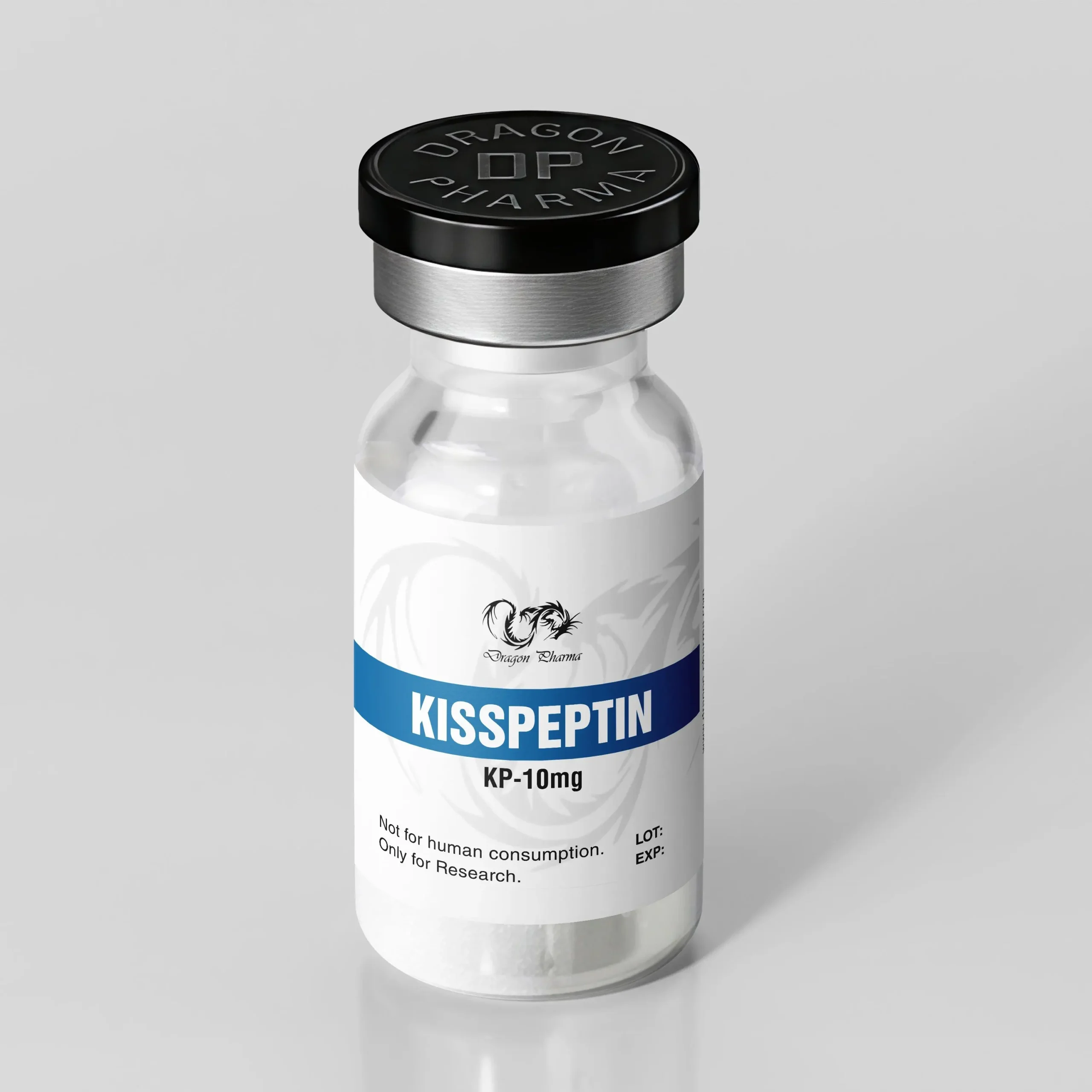
Kisspeptin
Original price was: $80.00.$48.00Current price is: $48.00.
Dragon Pharma Kisspeptin-10 Peptide Dragon Pharma Kisspeptin-10 is a research-grade synthetic decapeptide corresponding to the C-terminal 45–54 fragment of the KISS1 gene product. Ships US-only · 1–3 business days · Authorized Dragon Pharma distributor.
Kisspeptin – Product Overview
-10 Peptide Dragon Pharma Kisspeptin-10 is a research-grade synthetic decapeptide corresponding to the C-terminal 45–54 fragment of the KISS1 gene product. Carrying the sequence Tyr-Asn-Trp-Asn-Ser-Phe-Gly-Leu-Arg-Phe-NH₂ with a defining C-terminal amide characteristic of the kisspeptin RFamide family, Kisspeptin-10 is the shortest member of the kisspeptin peptide family that retains full binding activity at its cognate receptor KISS1R — also designated GPR54.
The compound has been characterized in laboratory research spanning neuroendocrine signaling, hypothalamic-pituitary-gonadal (HPG) axis regulation, cell motility inhibition, extracellular matrix biology, neuronal protection models, and cardiac fibroblast studies. Its established role as the primary endogenous ligand for KISS1R makes it a well-validated tool compound for GPR54 pharmacology and receptor signaling research across a broad range of in vitro applications.
Dragon Pharma Kisspeptin-10 is supplied as a lyophilized powder verified at ≥99% purity by HPLC, with LC-MS molecular identity confirmation and C-terminal amidation verification. Every batch ships with an independent third-party Certificate of Analysis. For research use only. Compound Specifications Property Value Product Dragon Pharma Kisspeptin-10 Common Names KP-10, Metastin (45–54), KiSS-1 (45–54) Peptide Type Synthetic decapeptide (10 residues) Amino Acid Sequence Tyr-Asn-Trp-Asn-Ser-Phe-Gly-Leu-Arg-Phe-NH₂ (YNWNSFGLRF-NH₂) Gene Source C-terminal fragment (residues 45–54) of KISS1 gene product Cognate Receptor KISS1R (GPR54) — Gq/11-coupled class A GPCR Molecular Formula C₆₃H₈₃N₁₇O₁₄ Molecular Weight 1302.5 g/mol Monoisotopic Mass 1301.63 Da CAS Number 374675-21-5 PubChem CID 25240297 InChIKey RITKWYDZSSQNJI-INXYWQKQSA-N C-Terminal Modification Amide (-NH₂) — defining feature of kisspeptin RFamide family Source Synthetic (controlled peptide synthesis) Form Lyophilized white powder Purity ≥99% (HPLC verified) Identity Verification LC-MS (sequence + mass + C-terminal amidation confirmed) COA Independent third-party, batch-specific Solubility Soluble in water; bacteriostatic water for reconstitution Storage (lyophilized) -20°C, protected from light; stable 24+ months Storage (reconstituted) 2–8°C, use within 28–30 days Research Classification Research use only Manufacturer Dragon Pharma Molecular Biology and Receptor Background Kisspeptin-10 is the C-terminal decapeptide fragment of the KISS1 gene product — the shortest naturally occurring kisspeptin family member that retains complete binding affinity at KISS1R (GPR54).
The kisspeptin family includes four processed peptide products: kisspeptin-54, kisspeptin-14, kisspeptin-13, and kisspeptin-10. All four share the same C-terminal decapeptide sequence, with kisspeptin-10 representing the biologically active core unit that defines receptor interaction across the entire family. KISS1R (GPR54) is a class A Gq/11-coupled G protein-coupled receptor located at chromosome 19p13.3.
Upon binding kisspeptin-10, KISS1R activates phospholipase C (PLC) via Gq/11, generating inositol trisphosphate (IP3) and diacylglycerol (DAG). This initiates intracellular calcium mobilization, protein kinase C activation, and downstream ERK1/2 phosphorylation cascades. Binding assays using CHO-KISS1R membrane preparations have characterized Ki values of approximately 1.59 nM (rat) and 2.33 nM (human KISS1R), with EC50 approximately 1.0 nM in CHO-GPR54 IP accumulation assays.
The KISS1 gene was originally identified as a metastasis suppressor in melanoma research — the product name KiSS-1 reflects its discovery context as a "Kisspeptin Suppressor Sequence" — before the central role of KISS1R in reproductive endocrinology was established through loss-of-function genetic studies in the mid-2000s. This dual research heritage — metastasis biology and neuroendocrine regulation — defines the breadth of laboratory applications for which KP-10 serves as a tool compound.
The C-terminal amide (-NH₂) modification is an essential structural feature. It defines Kisspeptin-10 as a member of the RFamide neuropeptide superfamily and is required for KISS1R binding potency. Dragon Pharma's LC-MS verification specifically confirms C-terminal amidation alongside sequence identity and molecular mass — a critical quality checkpoint that distinguishes the correctly modified research-grade compound from synthesis artefacts lacking the amide terminus.
Mechanism of Action KISS1R Activation and Gq/11 Signaling Cascade Kisspeptin-10 binds KISS1R with sub-nanomolar to low-nanomolar affinity, triggering a well-characterized intracellular signaling cascade. Receptor activation mobilizes Gq/11, which stimulates phospholipase C to generate IP3 and DAG from membrane phosphoinositide substrates. IP3 triggers endoplasmic reticulum calcium release, producing a rapid intracellular Ca²⁺ surge.
DAG activates protein kinase C, which phosphorylates downstream effectors including ERK1/2. The complete cascade — from receptor binding through ERK1/2 activation — provides multiple quantifiable research endpoints: IP1 accumulation (HTRF assay), Ca²⁺ flux (fluorometric), ERK1/2 phosphorylation (Western blot/ELISA), and β-arrestin recruitment assays.
Neuroendocrine Signaling and HPG Axis Regulation In hypothalamic research models, KISS1R activation by KP-10 stimulates GnRH (gonadotropin-releasing hormone) release from KNDy neurons (co-expressing kisspeptin, neurokinin B, and dynorphin). This positions kisspeptin-10 at the apex of the hypothalamic-pituitary-gonadal (HPG) axis — the master regulatory cascade governing gonadotropin secretion.
GnRH release drives pituitary LH (luteinizing hormone) and FSH (follicle-stimulating hormone) secretion, which in turn regulate gonadal steroid and gametogenesis biology downstream. Cell Motility Inhibition Independent of its neuroendocrine role, kisspeptin-10 has been characterized as an inhibitor of cell migration in placental and trophoblast cell models.
In HTR8/SVneo cells, KP-10 reduced migration through an ERK1/2-p90rsk-GSK3β-FAK signaling feedback loop (Roseweir et al., 2012). In first-trimester trophoblast cultures, KP-10 raised intracellular calcium and inhibited cell motility without altering proliferation rates (Bilban et al., 2004) — consistent with a signaling-specific rather than cytotoxic mechanism of action.
KISS1R-Independent Neuroprotective Activity A distinct and mechanistically significant finding is KP-10's documented neuroprotective activity in SH-SY5Y-derived cholinergic neurons via a pathway that operates independently of KISS1R. Simon et al. (2023) demonstrated that in neurons overexpressing wild-type or E46K mutant α-synuclein, kisspeptin-10 reduced apoptosis and mitochondrial depolarization through receptor-independent means.
This finding opens a research avenue for investigating direct peptide-protein interactions that bypass GPR54 signaling entirely — mechanistically distinct from all other characterized KP-10 activities. Cardiac Fibroblast and Extracellular Matrix Interactions Radwańska et al. (2023) demonstrated that kisspeptin-10 increases intracellular collagen content in cardiac fibroblast cultures through focal adhesion kinase (FAK) phosphorylation, alongside shifts in matrix metalloproteinase and tissue inhibitor expression.
This extends the documented biology of KP-10 beyond neuroendocrine and reproductive contexts into cardiovascular connective tissue research. Research Applications Research Area In Vitro Application KISS1R / GPR54 pharmacology Receptor binding characterization (Ki ~2.33 nM human), IP1 accumulation, Ca²⁺ flux, ERK1/2 phosphorylation, β-arrestin recruitment assays in KISS1R-expressing cell lines Neuroendocrine signaling HPG axis regulation studies; GnRH pulsatility models; KNDy neuron circuitry research; LH/FSH secretion pathway investigation Cell motility research Migration inhibition studies in trophoblast-derived cell models (HTR8/SVneo); ERK1/2-p90rsk-GSK3β-FAK feedback loop characterization Extracellular matrix biology MMP and TIMP expression studies; VEGF-A modulation downstream of KISS1R/ERK1/2; angiogenesis-related pathway investigation in trophoblast cultures Neuronal protection models α-synuclein-linked apoptosis and mitochondrial depolarization in SH-SY5Y cholinergic neurons; KISS1R-independent neuroprotective mechanism investigation Cardiac fibroblast research FAK phosphorylation and intracellular collagen content modulation; MMP/TIMP balance in myocardial fibroblast cultures Radiolabeling and imaging research Characterization of DOTA-conjugated analogues for gallium-68/lutetium-177 KISS1R-targeted radiotheranostic research (Kleynhans et al., 2025) Metastasis suppression biology KiSS-1/GPR54 system characterization in cancer cell line models; KISS1 expression analysis in melanoma, gastric, pancreatic, ovarian, and bladder cancer research contexts Kisspeptin Family: Understanding KP-10 in Context Kisspeptin-10 is the shortest and most widely used member of a peptide family that all derive from the same KISS1 gene product but differ in chain length.
All family members share the same C-terminal decapeptide sequence. Family Member Residues Notes Kisspeptin-54 54 residues Full-length KISS1 gene product; precursor to all shorter forms Kisspeptin-14 14 residues Processed fragment sharing C-terminal decapeptide Kisspeptin-13 13 residues Processed fragment sharing C-terminal decapeptide Kisspeptin-10 (KP-10) 10 residues Shortest fragment retaining full KISS1R binding; predominant research tool compound For most in vitro research applications, Kisspeptin-10 is the preferred tool compound.
Its smaller size simplifies synthesis, reduces production cost, and enables precise structure-activity studies. Receptor binding potency is equivalent to longer family members since the C-terminal decapeptide is the receptor interaction domain for the entire family. Quality Assurance Kisspeptin-10's C-t
Why Choose USA Dragon Pharma Kisspeptin?
USA Dragon Pharma is an authorized distributor of genuine Dragon Pharma products. Every order ships exclusively within the United States and typically arrives in 1–3 business days. Buy with confidence knowing you receive authentic, lab-verified compounds with fast domestic delivery.
| Form |
Peptide / Injectable |
|---|---|
| Shipping |
US Only · 1–3 Business Days |
| Compound Class |
Other |
| Primary Goal |
Performance |
| Brand |
USA Dragon Pharma |
You must be logged in to post a review.
Related products

Reviews
There are no reviews yet.