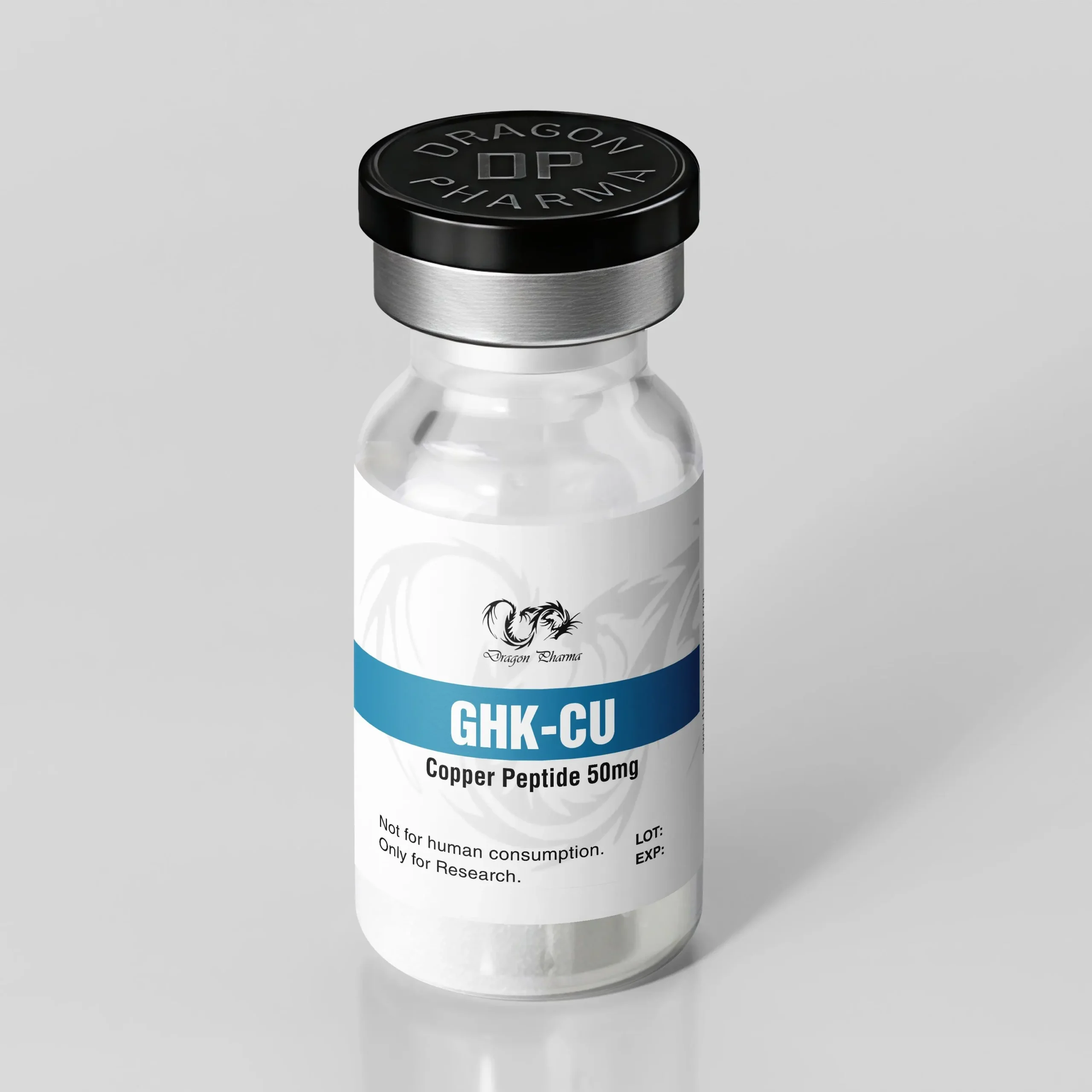
GHK-CU 50
Original price was: $40.00.$24.00Current price is: $24.00.
Pharmaceutical-Grade GHK-Cu for Research Applications Dragon Pharma GHK-Cu is a premium-quality copper-binding tripeptide manufactured to rigorous laboratory standards for scientific and research purposes. Ships US-only · 1–3 business days · Authorized Dragon Pharma distributor.
GHK-CU 50 – Product Overview
Pharmaceutical-Grade GHK-Cu for Research Applications Dragon Pharma GHK-Cu is a premium-quality copper-binding tripeptide manufactured to rigorous laboratory standards for scientific and research purposes. Composed of the naturally occurring amino acid sequence Glycine-Histidine-Lysine (GHK) complexed with a copper ion (Cu²⁺), GHK-Cu is one of the most extensively studied bioactive peptides in regenerative medicine, tissue remodeling, and skin biology.
Originally identified in human plasma by Dr. Loren Pickart, GHK-Cu occurs naturally throughout the body, although its concentration gradually declines with age. Scientific research has demonstrated its involvement in numerous biological processes, including collagen synthesis, elastin production, extracellular matrix remodeling, antioxidant defense, angiogenesis, and cellular repair.
These properties have made GHK-Cu a prominent subject of investigation in skin regeneration, wound healing, hair follicle biology, pulmonary research, neurological health, and gene expression studies. Every batch of Dragon Pharma GHK-Cu is produced under strict quality control procedures to ensure exceptional purity, consistency, and molecular integrity.
The peptide is supplied as a lyophilized (freeze-dried) powder without unnecessary fillers, helping preserve stability during storage while providing reliable performance for laboratory research. Peptide Specifications Property Value Product Dragon Pharma GHK-Cu Peptide Type Copper-Binding Tripeptide Peptide Sequence Gly-His-Lys Molecular Formula C14H24N6O4 Molecular Weight 340.38 g/mol CAS Number 49557-75-7 PubChem CID 73587 Synonyms Glycyl-L-Histidyl-L-Lysine, Prezatide, Gly-His-Lys Form Lyophilized Peptide Powder Purity Laboratory Tested Research Classification Research Use Only Molecular Structure and Biological Activity GHK-Cu consists of the naturally occurring tripeptide Glycine-Histidine-Lysine complexed with a copper ion, forming a highly bioactive peptide complex involved in numerous physiological processes.
Copper serves as an essential trace element required for enzymatic activity, connective tissue maintenance, antioxidant protection, and normal cellular metabolism. Research indicates that GHK-Cu functions as a signaling peptide capable of influencing multiple biological pathways associated with tissue remodeling, extracellular matrix maintenance, and cellular communication.
Experimental investigations suggest that it supports collagen formation, elastin organization, fibroblast activity, angiogenesis, and antioxidant defenses while helping regulate inflammatory responses during tissue repair. These characteristics have positioned GHK-Cu among the most extensively researched regenerative peptides in modern peptide science.
Mechanism of Action Rather than acting through a single biological target, GHK-Cu appears to influence numerous molecular signaling pathways involved in tissue repair, cellular regeneration, and oxidative balance. Current experimental research has investigated its interaction with: Collagen synthesis pathways Elastin production Fibroblast proliferation Extracellular matrix remodeling Vascular Endothelial Growth Factor (VEGF) Fibroblast Growth Factor-2 (FGF-2) Matrix Metalloproteinases (MMPs) Tissue Inhibitors of Metalloproteinases (TIMPs) Nuclear Factor Erythroid 2-Related Factor 2 (Nrf2) Nuclear Factor-kappa B (NF-κB) Transforming Growth Factor Beta (TGF-β1) Smad2/3 signaling Reactive Oxygen Species (ROS) regulation p38 MAPK signaling pathways These interconnected pathways are associated with connective tissue remodeling, antioxidant protection, immune regulation, angiogenesis, cellular migration, and normal wound repair.
Areas of Scientific Research Skin Regeneration and Tissue Remodeling GHK-Cu has become one of the most widely investigated peptides in dermatological and regenerative research. Numerous experimental studies have explored its role in improving connective tissue organization, collagen deposition, elastin synthesis, and dermal remodeling. Researchers continue to investigate GHK-Cu in laboratory models involving skin elasticity, dermal density, photodamage, fine lines, wrinkle formation, hyperpigmentation, and age-related structural changes.
Its ability to influence fibroblast activity and extracellular matrix remodeling has made it a significant area of interest within cosmetic science and regenerative medicine Wound Healing Research Experimental studies have demonstrated that GHK-Cu promotes several biological processes involved in tissue repair, including angiogenesis, cell migration, collagen synthesis, connective tissue accumulation, and growth factor production.
Research has examined its potential involvement in: Surgical wound models Incisional wound repair Burn and scald injuries Connective tissue regeneration Angiogenesis Fibroblast activation Extracellular matrix remodeling These findings continue to support ongoing research into tissue regeneration and wound biology. Hair Follicle Research GHK-Cu has attracted considerable interest in experimental hair biology due to its observed effects on cellular signaling involved in follicle maintenance and tissue remodeling.
Current research continues to investigate its potential relationship with: Hair follicle regeneration Dermal papilla cell activity Follicular vascularization Connective tissue remodeling Scalp biology Growth factor expression These experimental findings have contributed to its widespread use in cosmetic and hair-related research formulations.
Pulmonary Research Recent laboratory investigations have expanded into pulmonary biology, where GHK-Cu has demonstrated promising antioxidant and anti-inflammatory properties in experimental models. Published studies have explored its role in: Pulmonary fibrosis Idiopathic pulmonary fibrosis (IPF) Chronic obstructive pulmonary disease (COPD) Cigarette smoke-induced emphysema Acute lung injury (ALI) Oxidative stress regulation Inflammatory cytokine modulation Researchers continue evaluating its influence on Nrf2 activation, NF-κB inhibition, TGF-β1 signaling, epithelial-mesenchymal transition (EMT), collagen deposition, and matrix metalloproteinase regulation.
Neurodegenerative Research Growing scientific interest has focused on GHK-Cu's potential influence on nervous system biology and age-related neurological changes. Experimental studies have investigated laboratory models involving: Protein aggregation Copper and zinc homeostasis Neuroprotection Alzheimer's disease Amyloid plaque formation Cognitive decline Neuronal survival Central nervous system function Research suggests that GHK-Cu may influence gene expression patterns associated with healthy neuronal function and oxidative balance, making it an important peptide for ongoing neuroscience research.
Antibacterial Research Recent investigations have examined GHK-Cu nanoparticles as novel biomaterials with antibacterial properties. Experimental models have demonstrated activity against bacterial species including: Escherichia coli (E. coli) Staphylococcus aureus (S. aureus) Researchers continue evaluating self-assembled GHK-Cu nanoparticles for their potential role in tissue engineering, wound care materials, infection control, and biomedical applications.
Gene Expression Research One of the defining characteristics of GHK-Cu research is its ability to influence gene expression across numerous biological pathways. Experimental investigations have reported modulation of genes associated with: Tissue remodeling Cellular repair Inflammatory regulation Antioxidant defense Connective tissue maintenance Collagen metabolism Skin regeneration Pulmonary remodeling Nervous system function These findings continue to position GHK-Cu as a unique signaling peptide within regenerative medicine research.
Experimental Oncology Research Several laboratory studies have evaluated GHK-Cu in experimental models involving gene expression associated with breast, prostate, and colon cancer cells. Research has focused on how the peptide influences cellular signaling, tissue remodeling, and pathological gene expression. These investigations remain preclinical and continue to explore potential molecular mechanisms involved in healthy tissue maintenance.
Lyophilized Peptide Technology Dragon Pharma GHK-Cu is manufactured as a lyophilized peptide using advanced freeze-drying technology designed to maximize molecular stability and preserve peptide integrity. Advantages of lyophilization include: Improved molecular stability Extended shelf life Enhanced storage characteristics Preservation of peptide purity Reliable laboratory reconstitution Reduced molecular degradation No unnecessary fillers are used during manufacturing.
Storage and Handling For optimal stability, store the lyophilized peptide in a cool, dry environment protected from moisture, heat, and direct sunlight. Following laboratory reconstitution, researchers commonly store peptide solutions under refrigeration according to established laboratory protocols. Proper handling procedures help preserve peptide stability and molecular integrity throughout research applications.
Quality Assurance Dragon Pharma follows rigorous manufacturing and quality assurance standards to deliver dependable research compounds. Each production batch undergoes comprehensive laboratory evaluation, including: Identity verification Purity assessment Molecular weight confirmation Batch consistency analysis Quality control testing Contaminant screening Analytical techniques such as High-Performance Liquid Chromatography (HPLC) and Liquid Chromatography-Mass Spectrometry (LC-MS) are recognized industry standards for confirming peptide identity, purity, and molecular integrity.
Why Choose USA Dragon Pharma GHK-CU 50?
USA Dragon Pharma is an authorized distributor of genuine Dragon Pharma products. Every order ships exclusively within the United States and typically arrives in 1–3 business days. Buy with confidence knowing you receive authentic, lab-verified compounds with fast domestic delivery.
Researchers choose Dragon Pharma because of its commitment to pharmaceutical-quality manufacturing and reliable research compounds. Key advantages include: Pharmaceutical-grade manufacturing High-p
| Form |
Peptide / Injectable |
|---|---|
| Strength |
50mg |
| Compound Class |
Other |
| Primary Goal |
Performance |
| Brand |
USA Dragon Pharma |
| Shipping |
US Only · 1–3 Business Days |
You must be logged in to post a review.
Related products
Reviews
There are no reviews yet.