
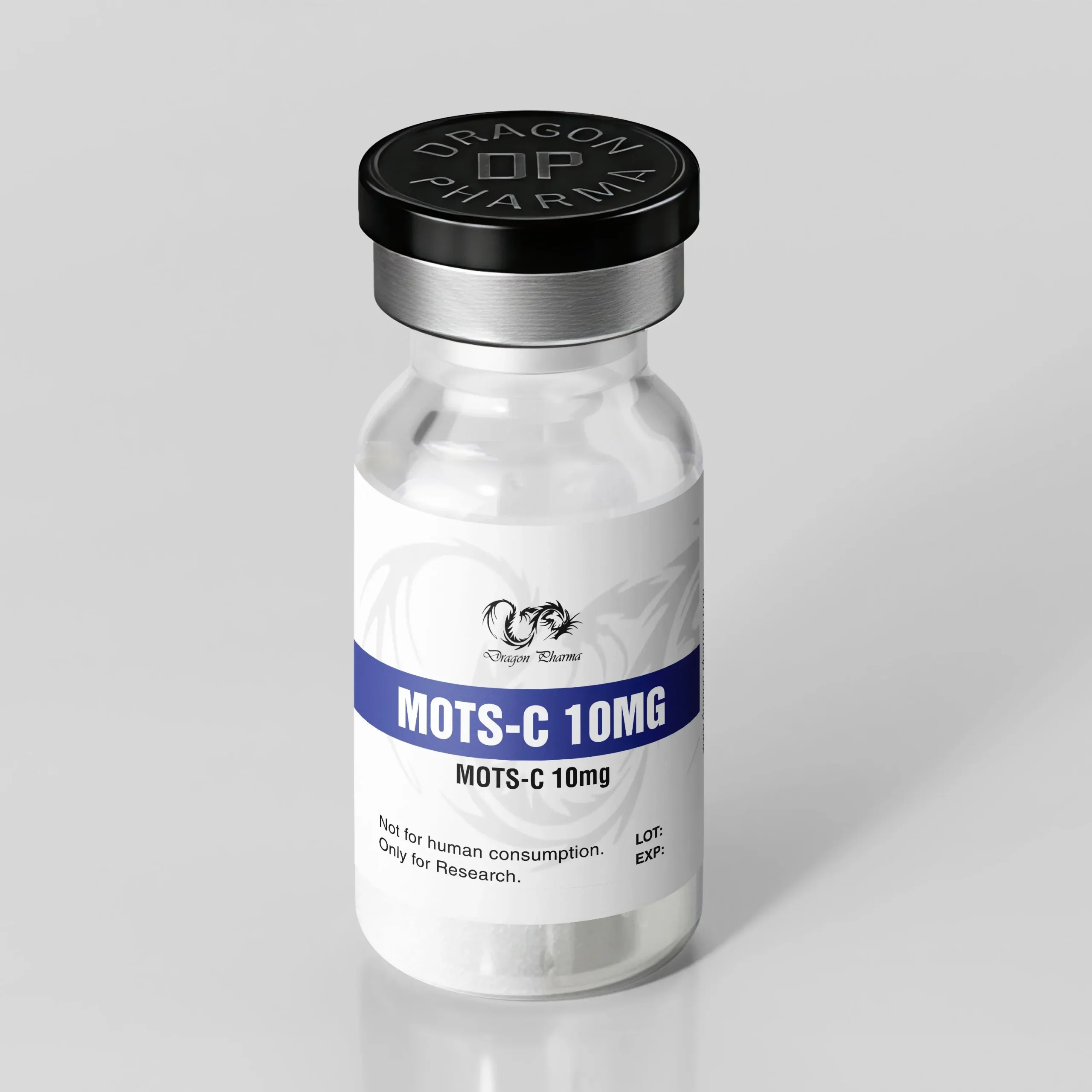


MOTS-c 10
Original price was: $65.00.$39.00Current price is: $39.00.
Dragon Pharma MOTS-c Peptide Dragon Pharma MOTS-c is a research-grade synthetic 16-amino acid peptide corresponding to the mitochondrial open reading frame of the 12S rRNA-c (MOTS-c) — a naturally occurring regulatory signal encoded within the mitochondrial genome itself rather t. Ships US-only · 1–3 business days · Authorized Dragon Pharma distributor.
MOTS-c 10 – Product Overview
Dragon Pharma MOTS-c Peptide Dragon Pharma MOTS-c is a research-grade synthetic 16-amino acid peptide corresponding to the mitochondrial open reading frame of the 12S rRNA-c (MOTS-c) — a naturally occurring regulatory signal encoded within the mitochondrial genome itself rather than nuclear DNA. Discovered and characterized in 2015, MOTS-c represents a paradigm shift in understanding mitochondrial biology: it is the first mitochondria-encoded peptide demonstrated to translocate to the cell nucleus and directly regulate nuclear gene expression in response to metabolic stress. MOTS-c primarily targets skeletal muscle and acts as a systemic metabolic regulator through AMPK (AMP-activated protein kinase) pathway activation. Its documented research applications span metabolic regulation, insulin sensitivity modeling, skeletal muscle homeostasis, neuroprotection, longevity biology, and exercise physiology. A specific polymorphism in the MOTS-c encoding region has been linked to exceptional longevity in certain populations, adding a genetic dimension to its anti-aging research relevance. Dragon Pharma MOTS-c is supplied as a lyophilized powder verified at ≥99% purity by HPLC, with LC-MS molecular identity confirmation. Every batch ships with an independent third-party Certificate of Analysis. For research use only. Compound Specifications Property Value Product Dragon Pharma MOTS-c Full Name Mitochondrial Open Reading Frame of the 12S rRNA-c Peptide Type Synthetic 16-amino acid mitochondria-derived peptide (MDP) Peptide Sequence Met-Arg-Trp-Gln-Glu-Met-Gly-Tyr-Ile-Phe-Tyr-Pro-Arg-Lys-Leu-Arg Molecular Formula C 101 H 152 N 28 O 22 S 2 Molecular Weight 2174.6 g/mol CAS Number 1627580-64-6 PubChem CID 255386757 Genome Origin Mitochondrial genome — 12S rRNA gene Discovery Year 2015 (Lee et al., Cell Metabolism) Primary Target Skeletal muscle; AMPK pathway activation Key Mechanism Folate cycle inhibition → AICAR accumulation → AMPK activation; nuclear translocation for gene regulation Form Lyophilized powder Purity ≥99% (HPLC verified) Identity Verification LC-MS (sequence + mass confirmed) COA Independent third-party, batch-specific Storage (lyophilized) -20°C, protected from light; stable 24+ months Storage (reconstituted) 2–8°C, use within 28 days Reconstitution Bacteriostatic water, aseptic conditions Research Classification Research use only Manufacturer Dragon Pharma What Makes MOTS-c Unique in Peptide Research Most research peptides are encoded by nuclear DNA. MOTS-c is not. It is encoded within the mitochondrial genome — specifically within the 12S rRNA gene — making it one of a small and recently identified class of mitochondria-derived peptides (MDPs) that communicate between the mitochondrion and the rest of the cell and organism. This genomic origin is biologically significant for two reasons. First, it places MOTS-c at the intersection of mitochondrial function and systemic metabolism in a way that nuclear-encoded peptides cannot occupy. Second, the mitochondrial genome is maternally inherited and accumulates mutations at a different rate than nuclear DNA — meaning MOTS-c-related polymorphisms carry implications for evolutionary biology, population longevity studies, and the genetic architecture of aging that are distinct from most peptide research compounds. The discovery that MOTS-c translocates from mitochondria to the cell nucleus in response to metabolic stress — where it then regulates nuclear gene expression — represents a fundamentally new understanding of mitochondrial signaling. Rather than being passive energy producers, mitochondria use peptides like MOTS-c as active regulatory signals that coordinate the cell's response to metabolic challenge across compartments. MOTS-c plasma levels decline with age in humans, positioning it as a candidate biomarker for metabolic aging and a research tool for studying the relationship between mitochondrial signaling capacity and age-related physiological decline. Mechanism of Action Folate Cycle Inhibition and AMPK Activation MOTS-c's primary metabolic mechanism operates through inhibition of the folate cycle — a metabolic pathway involved in one-carbon metabolism and de novo purine synthesis. By inhibiting the folate cycle, MOTS-c causes accumulation of 5-aminoimidazole-4-carboxamide-1-β-D-ribofuranoside (AICAR) — an endogenous AMPK activator. This AICAR accumulation activates AMPK independently of the cellular AMP:ATP ratio, a mechanistically distinct route of AMPK engagement compared to direct energy depletion. AMPK (AMP-activated protein kinase) is the cell's master energy sensor — a kinase that, when activated, triggers a coordinated metabolic response promoting energy production and reducing energy consumption. Key downstream effects of
- MOTS-c-mediated AMPK activation include: GLUT4 translocation — enhanced glucose transporter type 4 expression in skeletal muscle membranes, increasing glucose uptake independent of insulin signaling Lipid β-oxidation enhancement — increased fatty acid catabolism for energy production in metabolically stressed tissues Mitochondrial biogenesis — AMPK activation via PGC-1α promotes new mitochondria formation, expanding cellular energy production capacity Suppression of anabolic pathways — AMPK inhibits mTOR and other energy-consuming biosynthetic programs during metabolic stress Nuclear Translocation and Gene Expression Regulation Under conditions of metabolic stress, MOTS-c translocates from the mitochondria to the cell nucleus. In the nuclear environment, it interacts with stress-responsive transcription factors including NRF2 (nuclear factor erythroid 2-related factor 2), modulating gene programs associated with antioxidant responses and glucose metabolism. This nuclear activity is AMPK-dependent and represents a bidirectional mitochondria-nucleus communication axis not previously recognized in cell biology. Anti-Inflammatory Signaling Research has documented MOTS-c's inhibition of neuroinflammatory activation — specifically the suppression of astrocyte and microglial activation and reduction in proinflammatory cytokine production including TNF-α, IL-6, IL-1β, COX-2, and iNOS. These anti-inflammatory properties have been investigated in neuroprotection models of Alzheimer's disease pathology and traumatic brain injury. Myostatin Suppression and Muscle Signaling MOTS-c has been shown to reduce myostatin levels — a negative regulator of muscle mass — through the PTEN/AKT/FOXO1 signaling pathway, creating an anabolic environment in muscle tissue through anti-catabolic rather than direct anabolic mechanism. In exercise contexts, MOTS-c expression in skeletal muscle and circulation is induced by physical activity, establishing it as an endogenous exercise-responsive regulatory molecule. Research Applications Metabolic Regulation and Insulin Sensitivity Research MOTS-c's primary and best-characterized research application is in metabolic biology. Lee et al. (2015) demonstrated in animal models that MOTS-c prevents diet-induced obesity and insulin resistance by enhancing glucose metabolism in skeletal muscle through the AMPK/GLUT4 axis. Research in high-fat diet models has examined its capacity to prevent hyperinsulinemia and improve insulin-stimulated glucose uptake, reduce hepatic steatosis, and support fat oxidation through the AMPK-PGC-1α pathway. In postmenopausal models (ovariectomy-induced metabolic dysfunction), MOTS-c has been studied for its capacity to reduce fat mass, suppress inflammatory responses, sustain brown adipose tissue activity, and prevent weight gain and insulin resistance — creating a research platform for investigating hormonal transition-related metabolic dysfunction at the mitochondrial signaling level (Lu et al., 2019). Skeletal Muscle Homeostasis and Physical Performance Research Reynolds et al. (2021) established in Nature Communications that MOTS-c is an exercise-induced mitochondrial-encoded regulator of age-dependent physical decline and muscle homeostasis in both mice and humans.
- Key findings include: Exercise induces MOTS-c expression in skeletal muscle and circulation in human subjects MOTS-c treatment enhanced physical performance in young, middle-aged, and old mice — across age groups MOTS-c regulates nuclear genes related to metabolism and proteostasis in skeletal muscle MOTS-c aids myoblast adaptation to metabolic stress, supporting muscle function maintenance Kumagai et al. (2021) further documented that MOTS-c reduces myostatin and muscle atrophy signaling through the PTEN/AKT/FOXO1 pathway, suggesting research utility in sarcopenia and insulin resistance-induced muscle wasting models. Neuroprotection and Cognitive Function Research Research in neurodegeneration models has examined MOTS-c for its capacity to reduce neuroinflammation and improve cognitive function endpoints. Jiang et al. (2021) demonstrated that peripheral administration of a cell-penetrating MOTS-c analogue enhanced memory and reduced Aβ1-42- or LPS-induced memory impairment through neuroinflammation inhibition in preclinical models. Li et al. (2024) documented neuroprotective mechanisms in traumatic brain injury mouse models, including enhanced lipid β-oxidation for energy provision to the injured brain and reduced molecular damage and cell death. Longevity and Anti-Aging Research Fuku et al. (2015) identified a specific polymorphism in the MOTS-c encoding region of the mitochondrial genome that is associated with exceptional longevity in certain human populations — providing genetic evidence for MOTS-c's role in the biology of aging beyond its pharmacological effects. Mohtashami et al. (2022) reviewed MOTS-c's position within human aging and age-related disease, noting that circulating MOTS-c levels decline with age and that this decline may contribute to the metabolic deterioration characteristic of normal aging. Cardiac Research (2025 Update) A 2025 publication in Frontiers in Physiology (Pham et al.
Why Choose USA Dragon Pharma MOTS-c 10?
USA Dragon Pharma is an authorized distributor of genuine Dragon Pharma products. Every order ships exclusively within the United States and typically arrives in 1–3 business days. Buy with confidence knowing you receive authentic, lab-verified compounds with fast domestic delivery.
| Form |
Peptide / Injectable |
|---|---|
| Strength |
10mg |
| Compound Class |
Other |
| Primary Goal |
Cutting |
| Brand |
USA Dragon Pharma |
| Shipping |
US Only · 1–3 Business Days |
You must be logged in to post a review.
Related products

Reviews
There are no reviews yet.